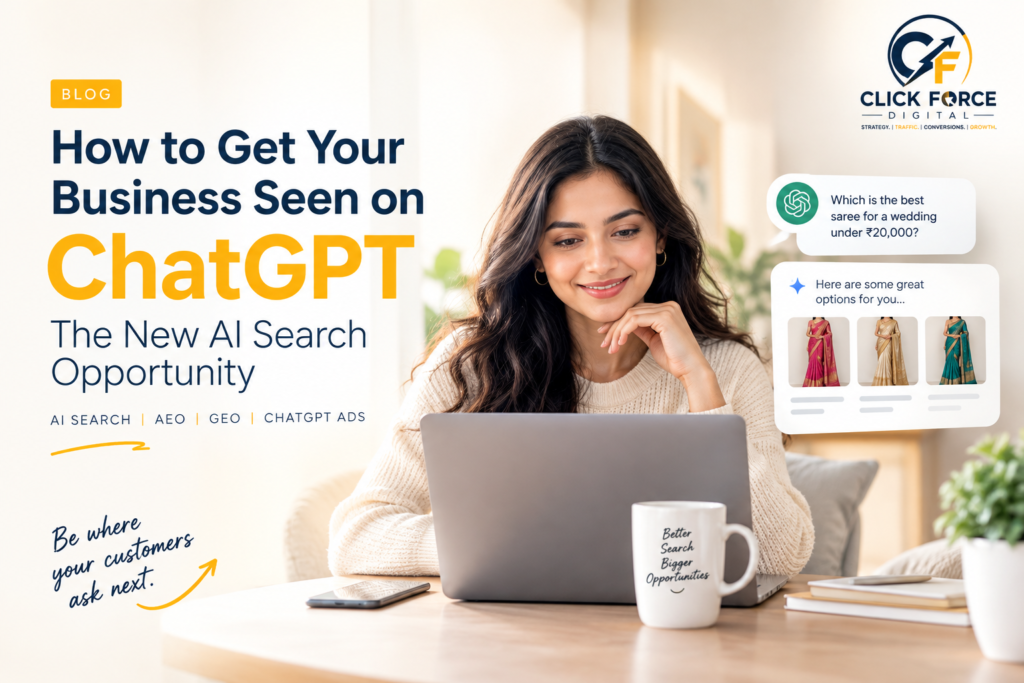
Imagine a potential customer typing this into ChatGPT:
“I need a premium silk saree for my sister’s wedding. My budget is ₹20,000. Which brands should I consider?”
Or:
“What are the best digital marketing agencies in Kolkata for a small ecommerce business?”
Or:
“Which accounting software is best for a small business in India?”
A few years ago, the customer would probably have searched Google, clicked through several websites, compared products and read reviews.
Today, the journey can start with a conversation.
This is the rise of AI search—and it is changing how businesses need to think about online visibility.
ChatGPT can now help users discover, compare and evaluate products. Its shopping experience can surface product options, pricing, reviews, merchant information and links to retailers. OpenAI says product results are selected based on factors including relevance to the user’s intent, product information, availability, price and other merchant or product data.
For businesses, this creates a new question:
How do you make your brand visible when customers stop searching for products and start asking AI what they should buy?
The Search Behaviour Shift: From Keywords to Conversations
Traditional search usually starts with keywords.
For example:
The user sees a page of search results and decides where to click.
AI search is different.
A customer might ask:
“I’m attending a Bengali wedding in Kolkata. I want an elegant silk saree under ₹15,000 that looks traditional but not too heavy. What would you recommend?”
That is no longer just a keyword.
It is intent, context, preferences, budget and a use case—all contained in one conversation.
This is why AI search optimization is becoming increasingly important.
Google itself says that SEO fundamentals remain relevant for generative AI search experiences, while terms such as AEO (Answer Engine Optimization) and GEO (Generative Engine Optimization) are increasingly used to describe efforts to improve visibility in AI-generated search experiences.
The important point is this:
You don’t need to abandon SEO. You need to build on it.
What Is AI Search Optimization?
AI search optimization is the process of making your business, website, products and content easier for AI-powered search systems to understand, evaluate and potentially recommend.
You may hear several terms used for this:
- AI SEO
- ChatGPT SEO
- AEO — Answer Engine Optimization
- GEO — Generative Engine Optimization
- Generative Search Optimization
- AI Search Optimization
Although the terminology varies, the underlying objective is similar:
Make your business easy for AI systems to understand and easy to trust.
Traditional SEO asks:
AI search asks a broader question:
“How do I become a credible answer or recommendation when someone asks an AI system about my category?”
That distinction is becoming increasingly important.
How Does ChatGPT Choose Products and Businesses?
There isn’t a simple formula that guarantees your business will appear in a ChatGPT recommendation.
And businesses should be cautious about anyone promising:
“We can guarantee your brand will rank #1 on ChatGPT.”
AI-generated recommendations are contextual and can change based on the user’s question, preferences and available information.
For shopping-related queries, OpenAI says ChatGPT considers information such as structured product data, product descriptions and other third-party content. Merchant selection can also consider factors such as availability, price, quality and whether the merchant is the maker or primary seller.
That means your digital presence matters.
And it starts with the basics.
7 Ways to Make Your Business More Visible on ChatGPT
1. Build a Website That Clearly Explains What You Sell
Don’t make AI—or your customers—guess what your business does.
Your website should clearly communicate:
- What you sell
- Who you sell to
- Where you operate
- Your key products or services
- Pricing or price ranges where appropriate
- Product specifications
- Features and benefits
- Shipping information
- Return policies
- Contact information
- Frequently asked questions
For ecommerce businesses, every important product should have a detailed product page rather than relying on a generic category page.
Instead of:
“Blue Saree — Beautiful traditional saree.”
provide useful information about:
fabric, colour, weave, occasion, measurements, blouse details, care instructions, price, availability and delivery.
The more clearly your business communicates its value, the easier it becomes for both people and machines to understand it.
2. Create Content Around Customer Questions
Traditional SEO often focuses heavily on keywords.
AI search makes questions and intent even more important.
Think about what your customers actually ask before purchasing.
For a fashion brand:
- Which saree is best for a wedding?
- What saree should I wear to a reception?
- Which silk saree is easiest to carry?
- What is the difference between Banarasi and Kanjivaram silk?
- Which saree is suitable for summer weddings?
For a software company:
- Which CRM is best for a small business?
- What is the best CRM under ₹50,000?
- How do I choose CRM software?
- Which CRM integrates with WhatsApp?
These questions can become:
blog posts, buying guides, FAQs, comparison pages and detailed product content.
You’re not simply creating content for Google.
You’re creating a knowledge base around your business.
3. Build Topical Authority
One isolated blog post is unlikely to establish your brand as an authority.
Suppose you sell premium sarees.
Instead of publishing one article titled:
build a complete content ecosystem:
- Types of silk sarees
- Banarasi vs Kanjivaram
- How to identify pure silk
- Best sarees for weddings
- Saree buying guide
- Saree care guide
- Best sarees for different body types
- Sarees under ₹10,000
- Sarees under ₹20,000
- Traditional sarees by region
This creates topical depth.
The same principle works for almost every industry.
4. Strengthen Your Brand’s Reputation Across the Web
Your website isn’t the only source of information about your business.
AI systems can encounter information from multiple sources.
That makes your broader digital footprint important.
Consider:
- Google Business Profile
- Industry directories
- Review platforms
- Publications
- News websites
- Industry associations
- Social media
- YouTube
- Expert interviews
- Customer reviews
- Relevant third-party websites
If your website says one thing while ten independent sources say something completely different, your digital identity becomes harder to interpret.
Consistency builds clarity.
And genuine third-party mentions can help demonstrate that your business exists beyond your own website.
5. Make Product Information Structured and Accurate
For ecommerce businesses, this is particularly important.
Your product catalogue should contain accurate information such as:
- Product name
- Brand
- Price
- Availability
- Product description
- Images
- Size
- Colour
- Material
- SKU
- Product category
- Product attributes
This isn’t just about traditional SEO.
It also helps shopping systems understand what you actually sell.
OpenAI says Shopify merchants already have product data integrated into ChatGPT through Shopify Catalog, while eligible merchants can also provide direct product feeds to keep product information up to date.
For ecommerce brands, clean product data is becoming a marketing asset.
6. Don’t Ignore Reviews
Imagine ChatGPT has to choose between two businesses.
One has a professionally designed website but very little independent information.
The other has:
- Hundreds of genuine customer reviews
- Detailed product information
- Strong online reputation
- Mentions on reputable websites
- Consistent business information
Which one looks easier to evaluate?
Reviews don’t guarantee AI recommendations, but they contribute to the information ecosystem surrounding a brand.
Encourage genuine customers to leave reviews on relevant platforms.
And don’t manufacture reviews.
AI visibility built on fake reputation isn’t a sustainable strategy.
7. Keep Investing in Traditional SEO
This may sound counterintuitive, but AI search doesn’t make SEO obsolete.
Google’s own guidance says that its generative AI search experiences continue to rely on core Search systems and relevant web content.
So your fundamentals still matter:
- Technical SEO
- Page speed
- Mobile usability
- Crawlability
- Internal linking
- Quality content
- Search intent
- Structured data
- Backlinks and digital authority
- Helpful product/service pages
The future isn’t:
SEO OR AI Search.
It is:
SEO + AI Search Optimization.
Where Do ChatGPT Ads Fit In?
There is another major development businesses need to watch: ChatGPT advertising.
OpenAI expanded direct ChatGPT Ads availability to India in August 2026, allowing advertisers to purchase ads through Ads Manager.
And the platform is evolving quickly.
OpenAI announced on October 5, 2026, that it is introducing a new visual advertising format designed to help people discover products and services, along with expanded measurement capabilities.
This creates an interesting distinction.
Organic AI visibility
Your business appears because the AI experience considers your business relevant to the user’s request.
Paid AI visibility
Your business can use advertising to reach relevant users within the ChatGPT environment.
These are not the same thing.
OpenAI states that shopping product results are separate from ads and are not influenced by advertising partnerships.
Think of it as another evolution of digital marketing:
Google SEO → Google Ads
Social content → Meta Ads
AI visibility → ChatGPT Ads
The exact rules and opportunities are still developing, but businesses should start paying attention now.
What Should Indian Businesses Do Right Now?
You don’t need to throw your entire marketing strategy out of the window.
Instead, start building an AI-ready digital presence.
Your roadmap could look like this:
Step 1: Fix your technical and traditional SEO foundation.
Step 2: Make product and service pages comprehensive.
Step 3: Identify the questions customers ask before purchasing.
Step 4: Build useful content around those questions.
Step 5: Strengthen reviews, reputation and third-party mentions.
Step 6: Improve structured product and business information.
Step 7: Monitor how AI platforms describe and recommend your brand.
Step 8: Experiment with ChatGPT Ads as the advertising ecosystem develops.
The Future of Search Is Becoming More Conversational
For decades, businesses competed to rank for keywords.
The next phase of search is likely to be much more conversational.
Customers may increasingly ask:
“Which laptop should I buy?”
“Which insurance policy is suitable for me?”
“Where should I buy a wedding saree?”
“What’s the best software for my business?”
The winning businesses won’t simply be those with the most keywords.
They will be businesses with clear information, strong reputation, useful content, trustworthy products and a digital presence that AI systems can understand.
The question for businesses is therefore no longer just:
It is becoming:
“When my customer asks AI what to buy, will my business be part of the answer?”
That is the opportunity businesses should start preparing for today.
At Click Force Digital, we help businesses build the digital foundations needed for this new search environment—from SEO and content strategy to Google Ads, Meta Ads and AI-focused digital marketing.
The future of search isn’t just about being found.
It’s about being recommended.