For years, Indian businesses have had a fairly familiar digital advertising playbook.
Google Ads for people searching for something.
Meta Ads for discovery and demand generation.
Amazon Ads for shoppers already close to a purchase.
Now there is a new player entering the picture: ChatGPT Ads.
OpenAI has started rolling out advertising inside ChatGPT, and India is now listed among the countries where advertisers can access the self-service Ads Manager.
That creates an interesting opportunity for Indian businesses—but it also raises plenty of questions.
How do ChatGPT Ads work? Are they similar to Google Ads? How much do they cost? Who should advertise on ChatGPT? And, most importantly, are ChatGPT Ads actually worth trying in India?
Let’s break it down.
What are ChatGPT Ads?
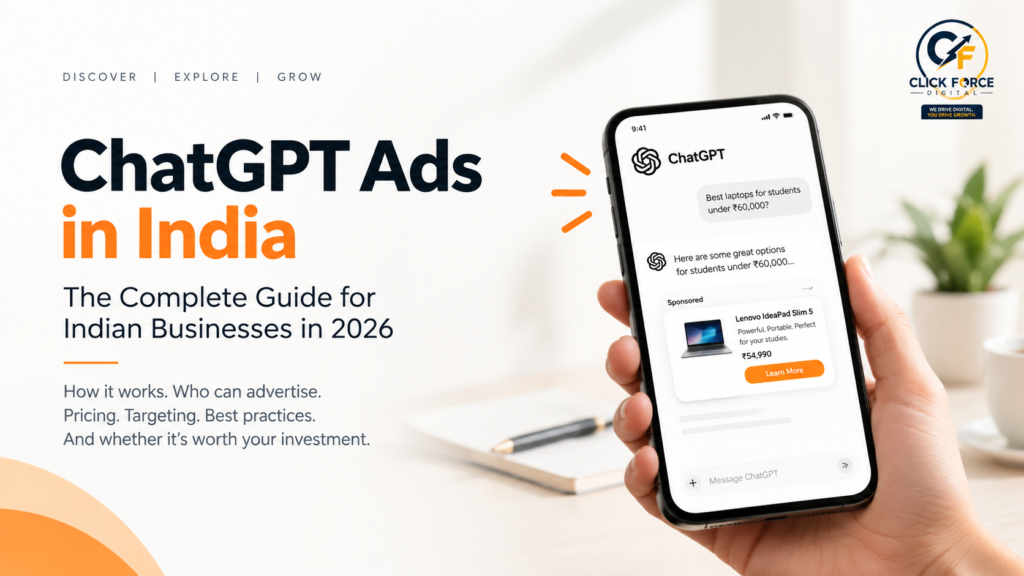
ChatGPT Ads are paid advertisements displayed within the ChatGPT experience.
The important distinction is that an advertisement does not become part of ChatGPT’s answer. OpenAI says ads are clearly identified as sponsored and are kept separate from the organic response generated by ChatGPT. Ads are designed to appear below responses, with elements such as the advertiser name, headline, description, landing page and, where applicable, an image.
This makes ChatGPT Ads different from traditional display advertising.
Instead of interrupting someone while they are reading an article or scrolling through social media, the ad can appear when a person is already using ChatGPT to research, compare options or make a decision.
Consider the difference.
Someone might search Google for:
“Best accounting software for small business”
But in ChatGPT they might ask:
“I run a small manufacturing company in India with 20 employees. Which accounting software would be easiest for my team to use?”
The second interaction provides considerably more conversational context.
That is one of the biggest reasons marketers are paying attention to ChatGPT Ads.
Is ChatGPT Ads available in India?
Yes.
OpenAI’s current Ads Manager availability page lists India as a country where self-service advertising is available. However, account creation and self-service eligibility are separate, and the legal entity being advertised and billed must be based in an eligible country.
This is an important update because much of the information published online about ChatGPT Ads in India was written while the platform was still in its international rollout phase.
The situation has now changed.
Indian businesses can start exploring the platform rather than simply waiting for its arrival.
How do ChatGPT Ads work?
The basic principle is contextual relevance.
OpenAI says its advertising system considers signals such as:
- The context and intent of the current conversation
- The advertiser’s landing page
- Ad headline and copy
- Advertiser-provided context hints
- Certain broader ChatGPT signals when ad personalization is enabled
Advertisers can also provide context hints describing the conversations, topics or keywords where their product may be relevant. These are not traditional exact-match keywords and do not guarantee that an ad will appear for a particular query.
This is a significant difference from traditional search advertising.
With Google Ads, advertisers often think in terms of keywords:
“best sherwani for men online“
“digital marketing agency Kolkata“
“running shoes under ₹5,000”
With ChatGPT Ads, marketers need to think more broadly:
What conversations would naturally lead someone to my product?
That requires a different advertising mindset.
ChatGPT Ads vs Google Ads: What’s the difference?
The easiest way to understand ChatGPT Ads is to compare them with Google Ads.
Google Ads
A user searches.
The advertiser competes for visibility against that search.
The user typically receives a page of search results and advertisements.
ChatGPT Ads
A user starts a conversation.
ChatGPT understands the context of that conversation.
A relevant sponsored placement may appear alongside the experience.
The distinction may sound subtle, but it could become strategically important.
Google is traditionally strongest when people already know what they are looking for.
ChatGPT can become interesting when people are exploring a problem, comparing alternatives or figuring out what they need in the first place.
That makes ChatGPT potentially valuable for businesses selling products or services that require consideration.
How much do ChatGPT Ads cost in India?
This is one area where marketers should be careful.
There is no sensible basis for claiming that ChatGPT Ads have a universal fixed price such as “₹X per click” or “₹X CPM” for every Indian advertiser.
OpenAI’s current advertising documentation says ChatGPT Ads supports two buying approaches:
CPM (cost per thousand impressions) for campaigns optimized toward reach.
CPC (cost per click) for campaigns optimized toward clicks.
The actual economics will depend on factors such as campaign objective, competition, audience/context, creative quality and performance.
For Indian advertisers, the right approach is therefore not to ask:
“What is the cheapest ChatGPT Ads CPC?”
Instead ask:
“Can ChatGPT generate a customer at an acceptable acquisition cost compared with my existing channels?”
That is the metric that matters.
Who should advertise on ChatGPT?
ChatGPT Ads will not automatically be suitable for every business.
At least initially, I would pay particular attention to businesses where customers spend time researching before buying.
1. SaaS and technology companies
Software products often require comparison and education.
Someone may ask ChatGPT to compare CRM platforms, accounting software, HR software or project-management tools.
That makes the environment naturally relevant to technology advertisers.
2. Professional services
Consultants, agencies, financial services, education providers and other professional businesses may find opportunities because customers frequently research before contacting a provider.
3. E-commerce brands
Products where customers actively seek recommendations could be interesting.
For example:
- Fashion
- Electronics
- Home improvement
- Beauty
- Fitness
- Travel
- Lifestyle products
However, advertisers should test carefully rather than assuming ChatGPT will automatically outperform Meta or Google Shopping.
4. Education and EdTech
Indian consumers spend considerable time researching courses, certifications, colleges and career options.
ChatGPT is already used extensively for learning and career-related tasks, making education an obvious category to test.
5. B2B companies
This could become one of the most interesting categories.
A business decision-maker might spend considerable time researching vendors before requesting a quotation.
If ChatGPT becomes part of that research process, advertising around those conversations could become valuable.
What businesses may not benefit immediately?
A common mistake would be assuming that every business needs to move its entire advertising budget to ChatGPT.
For example, a local restaurant may still get better results from Google Maps, Search and Meta.
A business selling a very low-cost commodity product may find that traditional shopping and social advertising offer stronger economics.
And businesses that depend almost entirely on immediate local intent may have limited reasons to shift budgets initially.
The sensible strategy is experimentation—not replacement.
How should Indian businesses prepare for ChatGPT Ads?
There is more to preparing for ChatGPT advertising than opening an Ads Manager account.
1. Improve your website
Your landing page needs to clearly explain:
- What you sell
- Who it is for
- Why it is different
- Pricing or commercial information where appropriate
- How customers can contact you
- Why customers should trust you
A confusing website will remain a problem regardless of the advertising platform.
2. Think beyond keywords
Start identifying the questions your customers ask before they buy.
For example, a saree brand should not only think about:
It should also think about conversations such as:
“What saree should I wear to a Bengali wedding?”
“Which silk saree is suitable for a bride’s mother?“
Those conversational needs reveal opportunities for messaging and positioning.
3. Build stronger brand information online
AI-driven discovery makes clear and consistent business information increasingly important.
Your website, product pages, reviews, social profiles and other credible online references should communicate the same basic facts about your business.
This isn’t about trying to “hack ChatGPT.”
It is about making your business easier for both humans and AI systems to understand.
4. Prepare better ad copy
ChatGPT is a conversational environment.
That means generic advertising slogans may not always be enough.
Instead of:
Consider:
“Need more qualified leads without wasting your Google Ads budget?”
The second statement starts with a problem a potential customer may actually be discussing.
Does ChatGPT Ads use people’s private conversations?
This is understandably one of the biggest concerns.
OpenAI says advertisers do not receive users’ chats, chat history, memories, names, email addresses, precise location or sensitive information.
Advertisers receive aggregated performance information such as views and clicks.
OpenAI also says that ads do not influence the answers generated by ChatGPT.
In other words, an advertiser cannot simply pay ChatGPT to recommend its product as the “best” answer.
That separation is important because the credibility of an AI assistant depends heavily on users trusting its answers.
Should you move your Google or Meta budget to ChatGPT?
No—not yet.
At least, not simply because ChatGPT Ads are new.
A better approach is to treat ChatGPT as an additional advertising channel and run controlled experiments.
Suppose a business spends ₹1 lakh per month on digital advertising.
Instead of immediately moving ₹50,000 from Google or Meta to ChatGPT, a sensible approach might be to allocate a small experimental budget, establish benchmarks and compare:
- Cost per click
- Qualified traffic
- Leads
- Conversion rate
- Cost per lead
- Sales
- Customer acquisition cost
- Return on ad spend
The winning channel should earn more budget.
Not the newest channel.
The bigger change: from search advertising to conversation advertising
This may ultimately be the most important part of the ChatGPT Ads story.
Google changed advertising by making intent searchable.
Social media changed advertising by making interest targetable.
AI assistants could make conversation commercially relevant.
Imagine a customer saying:
“I need a website for my manufacturing business. I have a budget of ₹2 lakh and need it launched within six weeks.”
That isn’t merely a keyword.
It is a business problem, a budget indication, a timeline and a potential buying signal wrapped into one conversation.
That is why marketers should watch this space carefully.
But it is also why businesses should avoid the hype.
ChatGPT Ads are new. Performance benchmarks are still developing, competition will change and the advertising ecosystem will evolve significantly over the next few years.
Final verdict: Are ChatGPT Ads worth exploring in India?
Yes—but as an experiment, not a replacement for everything else.
India is now an important market for ChatGPT advertising, and self-service Ads Manager access is available to eligible Indian businesses.
For brands selling products or services that require research, comparison and consideration, ChatGPT could become a particularly interesting advertising environment.
But the smartest advertisers won’t simply ask:
“How do I advertise on ChatGPT?”
They will ask:
“What conversations are my potential customers having before they buy from me?”
That shift—from keywords to conversations—may ultimately be the biggest change ChatGPT Ads bring to digital marketing.
And Indian businesses that start understanding that shift early could have an advantage as AI-powered discovery becomes a larger part of the customer journey.
Pingback: ChatGPT Ads vs Google Ads: Which Is Better for Indian Businesses?
Pingback: How to Advertise on ChatGPT in India: Step-by-Step Guide for Small Businesses
Pingback: How to Get Your Business Seen on ChatGPT When Customers Are Ready to Buy - ClickForce Digital - Best Digital Marketing Agency, Kolkata, India