
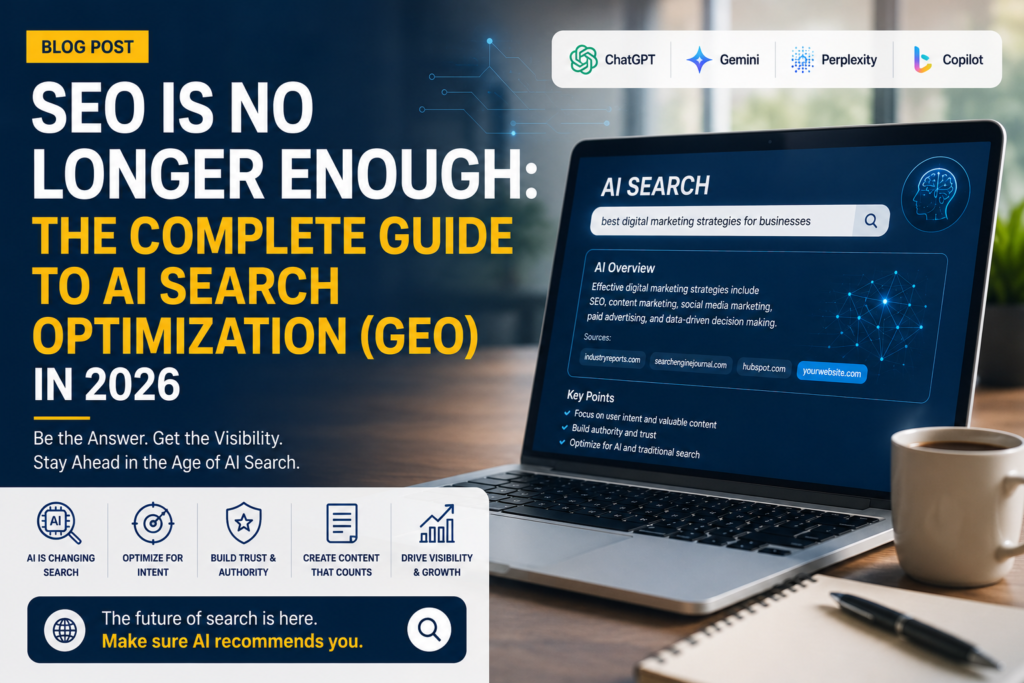
For over two decades, businesses competed for visibility by climbing Google’s search rankings. Ranking on the first page was the ultimate goal because higher rankings meant more clicks, more visitors, and ultimately more customers.
That reality is changing rapidly.
Today, millions of people ask questions directly to AI assistants like ChatGPT, Google Gemini, Claude, Microsoft Copilot, and Perplexity instead of browsing through dozens of websites.
Rather than presenting ten blue links, AI search engines generate complete answers in seconds.
This represents one of the biggest shifts in digital marketing since Google transformed web search.
Businesses that continue using only traditional SEO techniques risk losing visibility, even if they still rank well on Google.
The future belongs to businesses that optimize not only for search engines but also for AI-powered answer engines.
This new discipline is called Generative Engine Optimization (GEO).
What is Generative Engine Optimization (GEO)?
Generative Engine Optimization is the process of making your website and content easy for AI systems to understand, trust, and cite when generating answers.
Instead of focusing only on search rankings, GEO focuses on becoming a trusted information source.
Think about the difference:
Traditional SEO asks:
“How do I rank #1?”
GEO asks:
“How do I become the source AI trusts?”
That distinction changes everything.
Why AI Search is Changing Digital Marketing
Search behaviour has evolved dramatically.
Instead of searching:
Best CRM software
Users now ask:
I own a small manufacturing business with 25 employees. Which CRM integrates with WhatsApp and costs under ₹2,000 per month?
This conversational style gives AI much richer context.
AI then gathers information from multiple trusted sources, compares them, and generates one comprehensive answer.
If your business isn’t among those trusted sources, you simply don’t exist in that conversation.
SEO vs GEO: Understanding the Difference
Although SEO and GEO complement each other, they focus on different outcomes.
| Traditional SEO | Generative Engine Optimization |
|---|---|
| Improve rankings | Become an AI-cited source |
| Focus on keywords | Focus on intent and context |
| Drive clicks | Build authority and visibility |
| Optimize pages | Optimize knowledge |
| Compete for rankings | Compete for trust |
The best digital strategies in 2026 combine both.
Why Google AI Overviews Matter
Google’s AI Overviews are changing how users interact with search results.
Instead of clicking multiple websites, users often receive detailed summaries directly on the search page.
These summaries are generated from trusted websites.
If your business is referenced, your brand gains credibility.
If not, your competitors receive the attention.
Being cited by AI is becoming just as valuable as ranking first organically.
Create Content That AI Wants to Reference
AI models don’t reward fluff.
They reward clarity.
Every article should answer questions quickly and provide genuine value.
Some practical approaches include:
- Start with a clear answer.
- Use descriptive headings.
- Break information into logical sections.
- Include bullet points and comparison tables.
- Add real examples and practical advice.
- Update content regularly.
Well-structured content is easier for both humans and AI systems to understand.
Build Topical Authority Instead of Chasing Keywords
Publishing hundreds of unrelated blog posts is no longer an effective strategy.
Instead, create comprehensive topic clusters.
For example, a digital marketing agency might build a content hub around Google Ads with articles covering campaign setup, bidding strategies, Quality Score, remarketing, local search ads, Performance Max, and conversion tracking.
When multiple high-quality articles interlink around a subject, search engines and AI systems recognise genuine expertise.
Experience Matters More Than Ever
AI systems increasingly favour first-hand experience over generic advice.
Instead of saying:
“Google Ads improve leads.”
Say something like:
“After managing campaigns across retail, education, and ecommerce businesses, we consistently found that improving landing page relevance increased conversion rates significantly.”
Real-world insights demonstrate expertise and trustworthiness.
Structure Your Content for AI Readability
Formatting matters.
Content should include:
- Clear H2 and H3 headings
- Numbered processes
- Bullet lists
- Comparison tables
- Frequently Asked Questions
- Short paragraphs
- Concise summaries
This structure helps AI retrieve information accurately.
Strengthen Your Website’s Technical Foundation
Even the best content can underperform if the website is technically weak.
Key areas include:
Improve Website Speed
Fast-loading pages enhance both user experience and AI accessibility.
Implement Schema Markup
Structured data helps AI understand products, services, organisations, authors, FAQs, reviews, and events.
Ensure Mobile Responsiveness
Most searches now happen on mobile devices, making responsive design essential.
Optimise Core Web Vitals
Google continues to prioritise user experience metrics that reflect page stability, responsiveness, and loading performance.
Build Trust Signals Across Your Website
Trust is becoming a ranking factor for both search engines and AI.
Include:
- Detailed About page
- Author profiles
- Client testimonials
- Case studies
- Reviews
- Certifications
- Business contact details
- Privacy policy
- Secure HTTPS website
These elements reinforce credibility.
Don’t Ignore Conversational Search
AI queries resemble conversations.
Your content should answer questions naturally.
Consider including dedicated FAQ sections that address real customer concerns.
Examples:
- Is Google Ads better than Facebook Ads?
- How much should a small business spend on Google Ads?
- What is Performance Max?
- How long does SEO take to deliver results?
These questions mirror how users interact with AI assistants.
Measure Success Beyond Rankings
Traditional keyword rankings remain useful, but they no longer tell the whole story.
Monitor additional metrics such as:
- Organic traffic quality
- Brand searches
- AI referral traffic
- Featured snippets
- Google AI Overview appearances
- Conversion rates
- Engagement time
- Returning visitors
These provide a more complete picture of digital performance.
Common Mistakes Businesses Make
Many organisations continue to:
- Publish low-value AI-generated articles without human editing.
- Ignore technical SEO.
- Focus only on keywords.
- Neglect author credibility.
- Skip structured data.
- Produce thin content.
- Avoid updating older articles.
Avoiding these mistakes creates a stronger foundation for long-term visibility.
The Future of Search Belongs to Trusted Brands
Search is evolving from indexing pages to understanding knowledge.
Businesses that combine technical excellence, authentic expertise, high-quality content, and user-focused experiences will be the ones AI systems recommend.
The objective is no longer just to rank.
It is to become the answer.
Final Thoughts
SEO is not disappearing—it is evolving.
Generative Engine Optimization builds on the principles of good SEO while adapting to the way modern AI systems retrieve, evaluate, and present information.
Organizations that embrace this shift today will gain a significant competitive advantage as AI-powered search becomes the default way people discover information.
The businesses that invest in authority, trust, technical excellence, and genuinely helpful content won’t just survive the AI revolution—they’ll lead it.