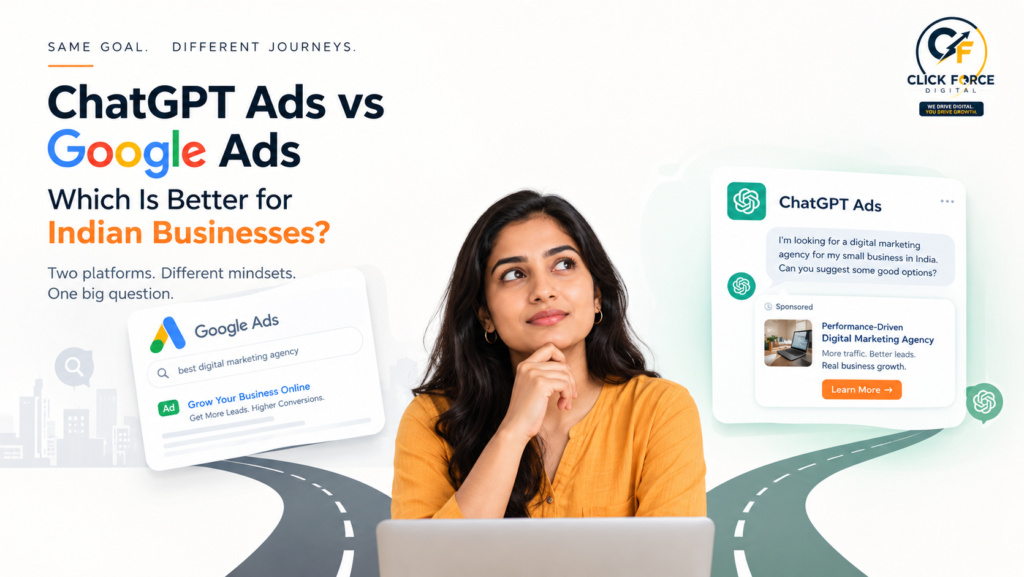
For Indian businesses, Google Ads has long been the obvious choice when the goal is to reach people who are already looking for a product or service.
Someone searches for “best digital marketing agency in Kolkata”, “buy silk saree online” or “best accounting software for small business”, and Google can place an advertisement directly in front of that potential customer.
But the way people discover products and make decisions is changing.
People are increasingly asking AI assistants questions instead of searching through ten different websites. That is where ChatGPT Ads enter the picture.
OpenAI has introduced a self-service Ads Manager and supports both CPC and CPM buying options, while Google Search Ads remain fundamentally built around matching advertisements with searches and keywords.
So, if you are an Indian business owner with a limited advertising budget, the obvious question is:
Should you spend your money on Google Ads or ChatGPT Ads?
The honest answer is: for most businesses today, Google Ads should remain the primary channel. But ChatGPT Ads could become a very interesting second channel as AI-driven discovery grows.
Here is why.
Google Ads and ChatGPT Ads solve slightly different problems
The easiest way to understand the difference is to look at the customer’s mindset.
Google Ads: “I am looking for something.”
A customer searches:
or:
Google identifies the search and advertisers can compete to appear for relevant queries. Search campaigns use keywords and matching systems to determine when an advertisement is eligible to appear.
This is search intent.
The customer has already started looking.
ChatGPT Ads: “Help me decide.”
Now imagine the same person asking ChatGPT:
“I am attending my sister’s wedding in Delhi. I want a stylish bridal lehenga under ₹50,000. I prefer something elegant rather than heavily embroidered. What should I look for?”
This is more than a keyword.
It is a conversation containing context, preferences, problems and intent.
That is potentially where ChatGPT advertising becomes interesting.
OpenAI describes its advertising system as being designed around the context of conversations while keeping advertisements clearly separate from ChatGPT’s answers.
ChatGPT Ads vs Google Ads: The key differences
| Factor | Google Ads | ChatGPT Ads |
|---|---|---|
| Primary environment | Search | AI conversation |
| Main signal | Search/query intent | Conversational context |
| Core strength | Capturing existing demand | Reaching people during research and consideration |
| Keyword targeting | Strong | Not traditional keyword targeting |
| CPC buying | Yes | Yes |
| CPM buying | Yes | Yes |
| Market maturity | Very mature | Emerging |
| Performance benchmarks | Extensive | Still developing |
| Best suited for | Search-driven demand | Research, comparison and consideration |
| Recommended role today | Primary channel for most businesses | Experimental/secondary channel |
The important point is that one does not necessarily replace the other.
1. Google Ads has a huge advantage: maturity
This is where Google is difficult to beat.
Google Ads has been around for decades. Indian advertisers have access to extensive campaign controls, keyword data, conversion tracking, audience tools and years of accumulated performance benchmarks.
An experienced Google Ads manager can look at a campaign and ask:
- Which keywords are converting?
- Which locations perform best?
- What is the cost per lead?
- Which search terms are wasting money?
- Which landing pages convert?
- What is the conversion rate?
- Which devices perform better?
There is a tremendous amount of historical data available.
ChatGPT advertising is still a relatively young channel.
OpenAI’s Ads Manager currently reports metrics including impressions, clicks, spend, CTR, average CPC, average CPM and conversions.
But advertisers simply do not yet have the same depth of historical industry benchmarks that exists with Google.
Advantage: Google Ads.
2. ChatGPT may have an advantage during the research phase
This is where things get more interesting.
Google is excellent when someone knows what they want.
But many buying decisions don’t start that way.
Consider someone looking for a financial product.
They might ask:
“I am 40, have two children and want to invest ₹15,000 a month for the next 10 years. Should I choose a mutual fund SIP or an insurance-linked investment?”
That person isn’t necessarily searching for a specific brand.
They are trying to understand the problem first.
The same applies to:
- Software
- Education
- Travel
- Financial products
- Professional services
- Electronics
- Cars
- Home improvement
- Healthcare-related information
- Business services
This is potentially ChatGPT’s biggest advertising opportunity.
Instead of competing only for a keyword, brands can potentially become visible around the decision-making journey.
3. Google is better at capturing immediate purchase intent
Suppose somebody searches:
“Buy Samsung refrigerator 400 litre”
That is a very different signal from:
“Which refrigerator should I buy for a family of four?”
The first person is probably much closer to purchase.
Google Search Ads are particularly powerful here because the advertiser can respond to an explicit search query. Google itself describes Search campaigns as a way to reach people actively searching for products and services.
For businesses where immediate demand generation is the priority, Google remains extremely difficult to ignore.
Think:
“dentist near me”
“AC repair Kolkata”
“buy running shoes”
“best CA for GST filing”
“website development company India“
These are classic Google opportunities.
Advantage: Google Ads.
4. ChatGPT could be powerful for consideration-heavy products
Now consider a product where customers typically spend days or weeks researching.
For example:
“Which CRM should a 25-person company use?”
or:
“What should I consider before buying a Shopify development service?”
or:
“Which MBA course is best for someone working full-time?”
These are conversations rather than straightforward searches.
This is the territory where ChatGPT Ads could eventually become particularly valuable.
OpenAI’s own advertising platform positions ChatGPT as a place where brands can be present while people are researching what to buy.
Potential advantage: ChatGPT Ads.
5. What about cost?
This is where businesses need to be careful.
You will probably come across articles claiming that ChatGPT Ads cost a particular amount per click or that Indian advertisers should expect a particular CPM.
Don’t take those numbers too seriously unless they come from current campaign data.
OpenAI currently supports both CPC and CPM buying for ChatGPT Ads.
But the more important question isn’t:
“Is ChatGPT cheaper than Google?”
It is:
“Which platform produces customers at a lower acquisition cost?”
A ₹50 click that generates a customer may be far better than a ₹10 click that generates nothing.
For an Indian SME, I’d measure:
Cost per qualified lead → Cost per customer → Revenue → Profit
before deciding where to increase the budget.
6. Google Ads has another major advantage: local intent
For Indian local businesses, Google remains incredibly powerful.
Consider:
“best physiotherapist in Kolkata”
“wedding photographer near me”
“CA in Salt Lake”
“restaurant near Park Street”
“digital marketing agency Kolkata”
Google has built an enormous ecosystem around local search, Maps, business listings and location-based advertising.
If your business depends heavily on local search intent, Google should almost certainly remain part of your strategy.
ChatGPT may eventually become important here too, but I would not abandon Google based on speculation.
7. Don’t underestimate ChatGPT’s privacy model
There is another important distinction.
OpenAI says advertisements are clearly labelled and kept separate from ChatGPT’s answers. It also says advertisers do not receive users’ chats, chat history, memories, names, email addresses or sensitive information.
This matters because advertising inside an AI assistant raises an obvious concern:
Will advertisers influence the answers?
According to OpenAI’s current advertising model, advertisements are separate from the generated answer.
That distinction will be important if ChatGPT advertising is to gain long-term user trust.
So, which is better for Indian businesses?
If you want leads today → Google Ads
For businesses already generating customers through search, Google should remain your first choice.
If your customers research before buying → Test ChatGPT Ads
Businesses selling complex products, professional services, SaaS, education and other consideration-heavy offerings should keep a close eye on ChatGPT.
If you are a local business → Google Ads
For location-based demand, Google has a significant advantage.
If you are an innovative D2C or technology brand → Test both
Use Google to capture existing demand and ChatGPT to experiment with reaching people during the research and consideration stage.
The smartest strategy isn’t Google vs ChatGPT
This is probably the most important takeaway.
The future may not be:
Google OR ChatGPT.
It could be:
Google + ChatGPT + Meta + organic search + AI discovery.
Think about the customer journey.
Someone sees a product on Instagram.
They search Google to investigate it.
They ask ChatGPT to compare alternatives.
They visit the company’s website.
They watch a YouTube review.
Then they finally purchase.
The winning brands won’t necessarily be the ones that pick one platform.
They will be the ones that understand what role each platform plays in the customer’s journey.
My recommendation for Indian businesses in 2026
If I were managing a ₹1 lakh monthly advertising budget for an Indian SME today, I wouldn’t suddenly move half of it from Google to ChatGPT simply because ChatGPT Ads are new.
I’d start with the channel that has proven economics.
For example:
Google Ads — ₹70,000
Meta Ads — ₹20,000
ChatGPT Ads experiment — ₹10,000
The exact split would depend heavily on the business.
Then I’d measure the ChatGPT campaign against Google using the same commercial metrics:
- Qualified leads
- Conversion rate
- Cost per customer
- Customer acquisition cost
- Revenue
- ROAS
- Profitability
If ChatGPT produces better-quality customers, increase the allocation.
If it doesn’t, keep testing or wait until the platform matures.
That’s how a performance marketer should approach a new advertising platform.
Not with hype. With data.
The verdict
Google Ads wins today. ChatGPT Ads is the platform to watch.
Google has the advantage of scale, maturity, search intent, local discovery, sophisticated campaign controls and years of performance data.
ChatGPT offers something fundamentally different: the possibility of reaching people while they are researching, comparing and making decisions through conversation.
That doesn’t make ChatGPT Ads a “Google killer.”
It makes it a new advertising environment worth testing.
For Indian businesses, the smartest approach in 2026 is therefore not to ask:
“Should I stop Google Ads and start ChatGPT Ads?”
Ask instead:
“Where in my customer’s decision-making journey can ChatGPT add incremental value?”
That is the question marketers should be testing.
Because the next big shift in digital advertising may not be from one search engine to another.
It may be the shift from search advertising to conversation advertising.
Pingback: ChatGPT Ads in India: Complete Guide for Businesses in 2026
Pingback: How to Advertise on ChatGPT in India: Step-by-Step Guide for Small Businesses