Google Ads vs Meta Ads
If you run a small business in India and you’ve got a limited ad budget, you’ve probably asked yourself this question at 11 PM while scrolling through your phone: Google Ads or Meta Ads — where should the money go?
Both platforms work. Both platforms also waste money if you use them wrong. The real answer isn’t “pick one,” it’s understanding what each platform is actually built for, then matching that to what your business needs right now.
Over the past few years, we’ve managed campaigns across ecommerce, education, healthcare, real estate, fashion and professional services. While every account behaves differently, one pattern appears consistently—search intent almost always beats interruption marketing when immediate conversions are the goal.
The Quick Answer
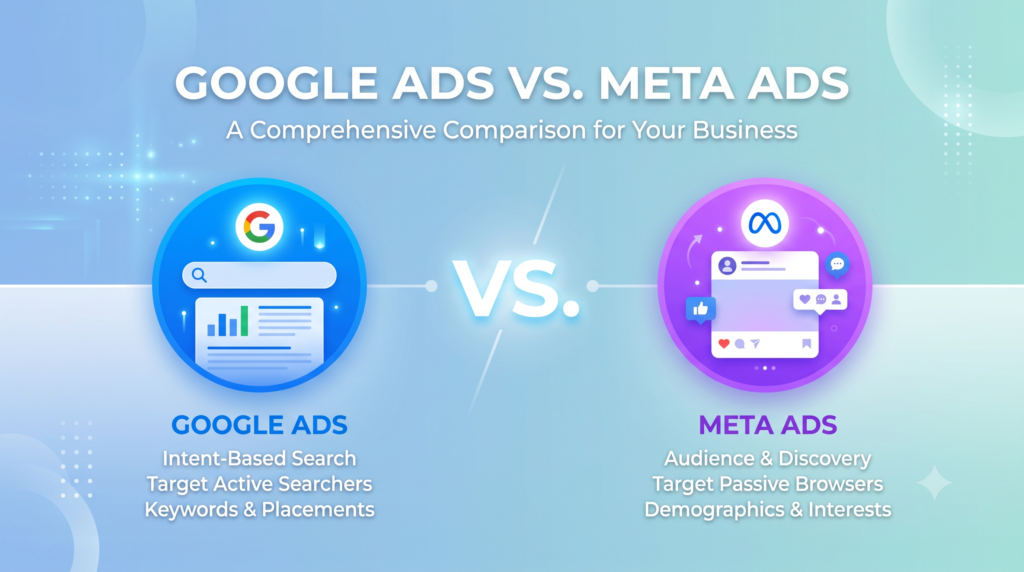
If someone is already looking for what you sell — a plumber, a CA, a wedding photographer, an ecommerce product — Google Ads usually wins. It captures people at the exact moment they’re searching.
If you’re trying to build awareness, sell something people didn’t know they wanted, or you’re in a visual category like fashion, food, or home décor — Meta Ads (Facebook + Instagram) tends to perform better, because it lets you interrupt scrolling and show up in front of people who fit your ideal customer profile, even if they weren’t searching for anything.
Most small businesses that grow fast in India end up using both, just at different funnel stages. But if you have to start with one, here’s the breakdown.
| Factor | Google Ads | Meta Ads |
|---|---|---|
| Intent | High — user is actively searching | Low to medium — user is browsing |
| Average CPC (India, general) | ₹8–₹40 depending on industry* | ₹3–₹15 depending on industry* |
| Best for | Services, local businesses, high-ticket B2B | Fashion, D2C, food, lifestyle, impulse buys |
| Targeting | Keywords and search terms | Interests, behaviour, lookalike audiences |
| Sales cycle fit | Shorter — bottom of funnel | Longer — top and middle of funnel |
| Visual storytelling | Limited | Strong |
| Time to see results | Faster for search-heavy niches | Slower, needs testing and creative rotation |
Why Intent Changes Everything
This is the part most business owners skip past, and it’s the single biggest reason one platform outperforms the other for a given business.
On Google, someone types “best interior designer in Kolkata” because they already want an interior designer. You’re not convincing them they need one — you’re convincing them to pick you. That’s a much easier sale, and it’s why service-based businesses (lawyers, doctors, contractors, consultants) usually see stronger ROI from Google Ads.
On Meta, nobody wakes up thinking “I hope an ad shows me a saree collection today.” They’re watching reels or checking on a cousin’s engagement photos. Your ad has to stop the scroll first, then create the want, then convert. That’s three jobs instead of one, which is why Meta campaigns lean so heavily on creative — the video, the image, the first three seconds — far more than Google Ads ever will.
Neither is better in the abstract. They’re solving different problems.
Cost Comparison: What You’ll Actually Pay in India
Numbers vary heavily by industry, but based on accounts we manage:
- Google Ads CPC for competitive B2B or legal keywords in metro cities can run ₹25–₹60 per click. For local services in Tier 2/3 cities, it can be as low as ₹5–₹15.
- Meta Ads CPC is generally cheaper per click, often ₹3–₹12, but conversion rates from that traffic tend to be lower since intent is weaker.
Here’s the part that trips people up: cheaper clicks don’t mean cheaper customers. We’ve had clients pay less per click on Meta but end up with a higher cost per actual sale, because the audience needed more convincing. Meanwhile a Google campaign with pricier clicks converted at nearly double the rate because the searcher was already sold on the category — they just needed to pick a business.
So when you’re comparing platforms, ignore cost-per-click as your main metric. Look at cost per lead or cost per purchase instead. That’s the number that actually tells you which platform is making you money.
Festival Season Changes the Math
If you’re an Indian business, this matters more than most global guides mention. During Navratri, Diwali, and wedding season (roughly October through February, plus Akshaya Tritiya), ad costs on both platforms spike because every brand is competing for the same eyeballs at once.
Meta CPCs during peak festive weeks can jump 40–70% compared to off-season months. Google search volume for gift-related and fashion-related keywords also spikes, but because intent is already high, the ROI often holds up better than on Meta, where you’re now competing with louder, flashier festive creative from bigger brands.
Our approach for clients in fashion, gifting, and ecommerce is to start Meta brand-awareness campaigns 3–4 weeks before the festival, then shift budget toward Google Search and Shopping ads in the final 7–10 days when people are actually ready to buy.
When Google Ads Wins
- Home services, legal, medical, and other “problem-aware” businesses
- High-ticket B2B where a single client is worth lakhs
- Ecommerce brands with strong branded search volume
- Businesses in a specific city or locality (Local Services + Search combo)
When Meta Ads Wins
- Fashion, jewellery, and lifestyle D2C brands
- Food and beverage, especially cloud kitchens and new restaurants
- Anything that photographs or films well
- Brands trying to build a following before people start searching for them by name
A Real Example
One of our ecommerce clients in the ethnic wear space was putting almost their entire budget into Meta because it “felt cheaper.” Clicks were cheap, but the cart abandonment rate was high because most of that traffic was cold — people who liked the visuals but weren’t ready to buy sarees that day.
We shifted 30% of the budget into Google Shopping and Search, targeting people actively typing terms like “banarasi saree online” and “wedding saree Kolkata.” Cost per click went up. Cost per actual order dropped by almost a third within six weeks, because that traffic arrived already wanting to purchase, not just admire.
Many ecommerce businesses now combine Search with Performance Max campaigns to capture customers across Search, YouTube, Gmail, Discover and Shopping from a single campaign.
That’s the pattern we see again and again: Meta builds the audience, Google closes a chunk of them.
So, Which Should You Choose?
Ask yourself three questions:
- Are people already searching for what I sell? If yes, start with Google.
- Does my product rely on being seen to be wanted? If yes, Meta needs to be in the mix.
- What’s my budget? Under roughly ₹15,000–₹20,000/month, pick one platform and go deep instead of splitting thin across both. Spreading a small budget across two platforms usually means neither gets enough data to optimise properly.
If your budget allows for both, a common starting split we recommend for D2C and ecommerce clients is 60% Meta (awareness and retargeting) and 40% Google (search and shopping for people ready to buy). For service businesses, we usually flip that — 70% Google, 30% Meta for brand visibility.
FAQs
Is Google Ads more expensive than Meta Ads in India? Generally yes, per click. But Google traffic tends to convert at a higher rate because of stronger purchase intent, so the actual cost per sale can end up similar or even lower.
Can a small business run both Google Ads and Meta Ads at the same time? Yes, and many do — but only once the budget is large enough to give each platform enough spend to gather useful data, typically upwards of ₹25,000–₹30,000/month combined.
Which platform is better for a new business with no existing customers? Meta Ads is usually better for pure awareness building since it can introduce your brand to people who’ve never heard of you. Google Ads works best once there’s already some level of demand or search volume for what you offer.
Do festival campaigns need a different platform strategy? Yes. Awareness-building on Meta should start weeks ahead of a festival, while Google Search and Shopping budgets should be increased closer to the actual buying window when intent peaks.
Not sure where your budget should actually go? Get a free ad account audit from ClickForce Digital and we’ll tell you honestly — not just what sounds good.
Read more: Google Analytics | Digital Marketing Trends in 2026
Pingback: ChatGPT Ads in India: Complete Guide for Businesses in 2026
Pingback: PPC Budget Going to Waste? 5 Silent Google Ads Mistakes