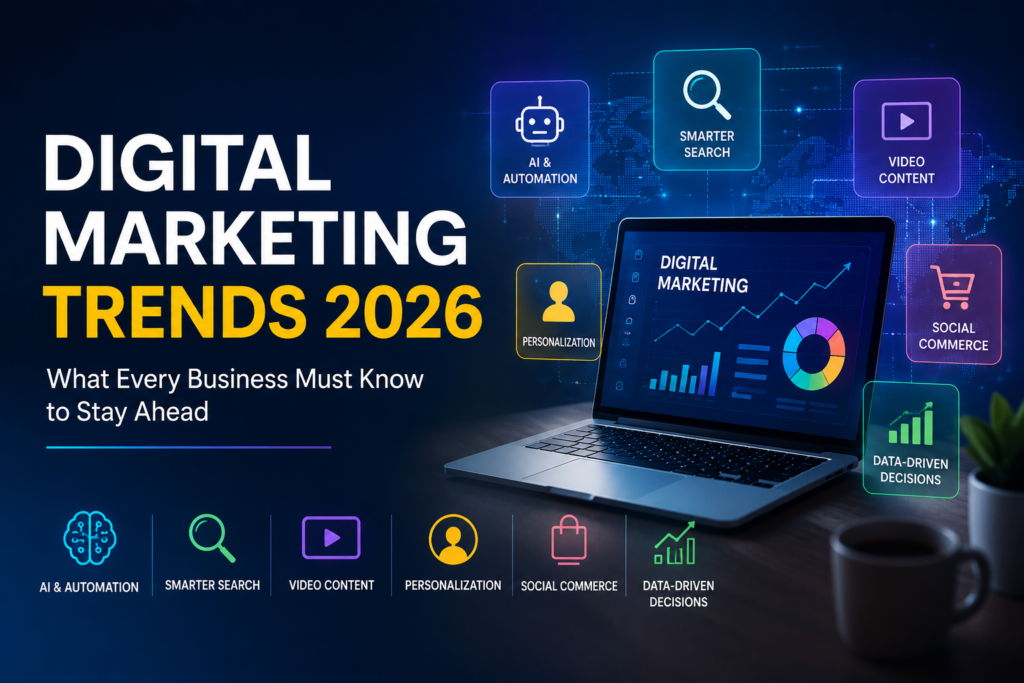
The digital marketing landscape has never evolved as quickly as it is today. Advances in artificial intelligence, changing consumer behavior, privacy regulations, and new search technologies are transforming how businesses attract, engage, and convert customers. Strategies that delivered excellent results just a year ago may no longer be enough to remain competitive.
Whether you’re a startup, a local business, or an established enterprise, understanding the latest digital marketing trends is essential for sustainable growth. Businesses that embrace innovation early gain a significant competitive advantage, while those slow to adapt risk losing visibility, leads, and revenue.
In this article, we’ll explore the biggest digital marketing trends shaping 2026 and how businesses can leverage them to achieve measurable success.
1. Artificial Intelligence is Becoming Every Marketer’s Best Assistant
Artificial Intelligence (AI) has moved far beyond being a buzzword. It is now an integral part of modern marketing strategies.
Businesses are using AI to:
- Generate high-quality content
- Create personalized email campaigns
- Analyze customer behavior
- Optimize advertising campaigns
- Improve customer support through intelligent chatbots
- Predict purchasing patterns
However, successful businesses are learning that AI should enhance human creativity—not replace it. While AI can accelerate content production and campaign management, human expertise remains essential for strategy, creativity, and brand storytelling.
Companies combining AI automation with human insights are achieving faster growth and better customer engagement.
2. Search is Changing with AI-Powered Results
Traditional search engine optimization (SEO) is undergoing a major transformation.
Search engines increasingly provide AI-generated summaries that answer user questions directly. This means businesses must optimize not only for rankings but also for being cited within AI-generated answers.
Modern SEO now focuses on:
- High-quality original content
- Demonstrating expertise and credibility
- Answering customer questions clearly
- Using structured content
- Improving website speed and user experience
Brands producing genuinely helpful content are more likely to appear in both traditional search results and AI-powered search experiences.
3. Video Content Continues to Dominate
Consumers increasingly prefer watching over reading.
Short-form videos on social media platforms consistently generate higher engagement than static posts.
Businesses are successfully using videos to:
- Demonstrate products
- Share customer testimonials
- Explain services
- Showcase behind-the-scenes activities
- Educate audiences
Video marketing builds trust more quickly because people connect better with faces, voices, and authentic experiences.
Even simple smartphone videos often outperform highly polished corporate advertisements when they provide genuine value.
4. Personalization is No Longer Optional
Modern consumers expect businesses to understand their preferences.
Generic marketing messages are becoming less effective, while personalized experiences significantly improve conversion rates.
Businesses now personalize:
- Website content
- Email campaigns
- Product recommendations
- Advertising creatives
- Promotional offers
Using customer data responsibly allows businesses to deliver relevant experiences that increase satisfaction and encourage repeat purchases.
Customers are more likely to engage with brands that understand their needs rather than broadcasting one-size-fits-all messages.
5. First-Party Data is Becoming More Valuable
Growing privacy regulations and reduced third-party cookie tracking are changing how marketers collect customer information.
Instead of relying on external data sources, businesses are focusing on building their own customer databases through:
- Email subscriptions
- Loyalty programs
- Customer accounts
- Website registrations
- Interactive quizzes and surveys
First-party data provides better accuracy while maintaining customer trust and complying with privacy regulations.
Businesses investing in strong customer relationships today will be better prepared for tomorrow’s privacy-first digital ecosystem.
6. Voice Search and Conversational Search Are Growing
With the increasing popularity of voice assistants and conversational AI, people search differently than before.
Instead of typing:
“best digital marketing agency”
Users may ask:
“Which digital marketing agency can help grow my small business?”
This shift requires businesses to optimize for natural language, question-based keywords, and conversational content.
Creating FAQ pages and answering real customer questions can significantly improve visibility.
7. Social Commerce is Expanding Rapidly
Social media is no longer just for brand awareness.
Customers increasingly discover, evaluate, and purchase products without leaving social platforms.
Features like:
- In-app shopping
- Live product demonstrations
- Influencer recommendations
- Product tagging
- Interactive shopping experiences
are making social commerce one of the fastest-growing digital marketing channels.
Businesses that integrate shopping directly into their social media presence create smoother customer journeys and higher conversion rates.
8. Influencer Marketing is Becoming More Authentic
The era of celebrity-only influencer marketing is fading.
Micro-influencers and niche creators are delivering stronger engagement because their audiences trust them more.
Businesses are partnering with creators who genuinely align with their products rather than simply focusing on follower count.
Authenticity has become one of the most valuable assets in influencer marketing.
Consumers can quickly identify forced promotions, making genuine recommendations significantly more effective.
9. Data Analytics is Driving Better Decisions
Successful marketing is no longer based on assumptions.
Businesses are increasingly relying on data to understand:
- Customer journeys
- Website performance
- Campaign ROI
- Advertising effectiveness
- Conversion funnels
- Customer lifetime value
Tools like Google Analytics 4, CRM platforms, and AI-powered dashboards enable marketers to identify what works and continuously optimize campaigns.
Data-driven businesses typically achieve higher returns on their marketing investments than those relying on intuition alone.
10. Brand Trust is Becoming a Competitive Advantage
Consumers have countless choices online.
Price is no longer the only deciding factor.
Customers increasingly choose businesses they trust.
Trust is built through:
- Transparent communication
- Consistent branding
- Honest customer reviews
- Educational content
- Fast customer support
- Secure websites
- Reliable service
Businesses investing in long-term relationships rather than short-term sales often see stronger customer loyalty and higher referral rates.
The Growing Importance of Omnichannel Marketing
Customers rarely interact with a business through a single platform.
A typical customer journey may include:
- Discovering your brand on social media
- Reading blog articles
- Watching YouTube videos
- Visiting your website
- Receiving email newsletters
- Seeing remarketing advertisements
- Finally making a purchase
Successful businesses ensure these touchpoints work together seamlessly.
An integrated marketing strategy creates consistent messaging across every platform, improving both customer experience and conversion rates.
Final Thoughts
Digital marketing in 2026 is more intelligent, more personalized, and more customer-centric than ever before. Businesses that embrace AI, invest in high-quality content, prioritize customer experience, and make data-driven decisions will be well-positioned for long-term growth.
The key is not to chase every new trend but to adopt the innovations that align with your business goals and customer needs. A balanced approach—combining technology with human creativity and strategic thinking—will continue to deliver the strongest results.
As the digital landscape evolves, businesses that remain agile, continuously learn, and adapt to changing consumer expectations will stay ahead of the competition. The future of digital marketing belongs to brands that build trust, create value, and place customers at the center of every marketing decision.
Author: Ravi Kumar Singh